
Pushpay · 2024–Present

Not faster.
Finally possible.

The real value of AI in design systems isn't speed. It's unlocking work that could never be justified before — audits too large to run, documentation that never got written, debt that accumulated because fixing it properly would take weeks nobody had.

My role

Senior UX Designer · Design System Lead
Sole architect of the AI-augmented DS workflow

Tools

Claude Figma Console MCP DS Assistant MCP Dovetail Pendo Atlassian / Jira Storybook GitHub

Approach

Test → validate → run once a human is no longer needed

88%
Faster component migration
92%
Faster DS documentation
~95%
Faster icon find & replace
17k
Variables migrated in one day

The work we wanted
but couldn't justify.

Every design system accumulates work everyone knows needs doing — but the time can never be justified against the roadmap. So it gets deferred. Workarounds get built. The debt grows quietly.

At Pushpay: components that shipped without documentation. Variable structures that needed auditing across 17,000 tokens. A library cross-referenced against Storybook and GitHub to find inconsistencies. Weeks of focused effort from someone who had neither the weeks nor the focus.

"It was quicker to find workarounds than to fix it properly. The time it would take couldn't be justified. So the debt stayed."

AI didn't make this work faster. It made it possible for the first time — by replacing hours that were never design decisions to begin with.
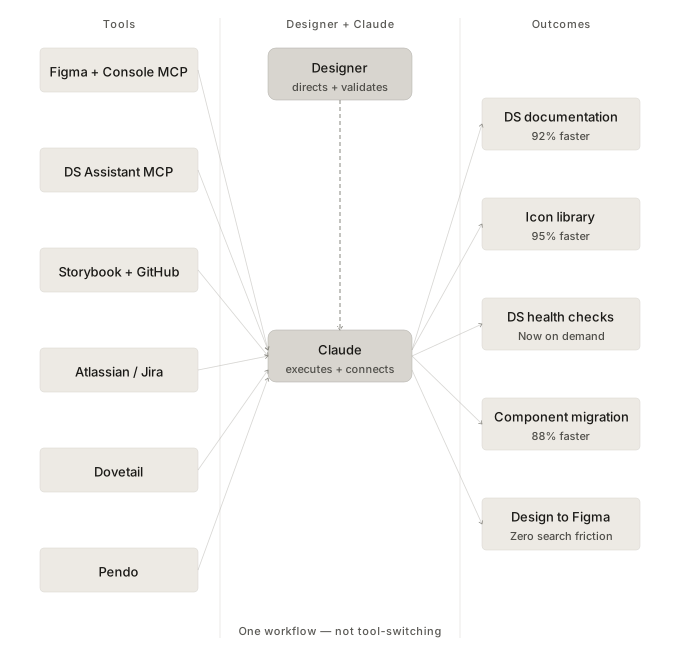
One workflow.
Not tool-switching.

The key isn't any single tool — it's connecting them. Claude becomes the connective tissue: context stays alive across tools, and outputs feed directly into the next step.

Diagram showing six tools feeding into Claude, directed by the designer, producing five design system outcomes
The stack
Claude
Reasoning, auditing, generating documentation, creating Jira tickets from findings, making bulk Figma updates
Figma Console MCP
Direct Figma access — read and write variables, audit component usage, push updates without manual work in the UI
DS Assistant MCP
Design system knowledge layer — component metadata, token context, usage rules
Storybook / GitHub
Engineering source of truth — cross-referenced against Figma to find parity gaps and inconsistencies
Atlassian / Jira
Audit findings converted directly into tickets — no manual transcription step
Dovetail · Pendo
Research and usage data feeding design decisions — not just design intuition

Work that didn't exist
before this workflow.

Some of this work got faster. The more interesting category is work that wasn't happening at all — because the cost could never be justified against other priorities.

Full DS audit — Prism + component library

A full audit of scope, descriptions, naming, variable usage, and component health across 500+ variables and components. Manually, it would surface issues faster than they could be resolved. Now it runs on demand, and findings flow directly into Jira.

Previously: impractical at this scale

Documenting components that shipped without docs

Components ship under deadline and never get documented. Retroactively writing structured docs — usage rules, variants, accessibility notes — was a backlog that only grew. 60 minutes per component became 5. The backlog is now clearable.

Previously: always deferred, never done

17k variable migration in one day

Updating the entire variable structure — auditing old token usage, replacing hardcoded values, pushing the new semantic architecture across the library. Not 17,000 manual updates. One structured operation, validated, run through Claude directly to Figma. A week of work became a day.

Previously: would have taken weeks

Cross-channel parity checks

Cross-referencing Figma against Storybook against the GitHub repo — finding where they diverge, where components don't match, where design intent isn't reflected in the built output. The kind of audit that happens once a year if you're lucky. Now it's on-demand.

Previously: happened rarely, if ever

Icon library rebuild at scale

100 icons, ~30 seconds each to find, configure, and place correctly. ~80 minutes of work requiring zero design judgment. With Claude, a few minutes. The designer focuses on which icons, not on placing them.

Previously: 80 minutes of non-design work

Strategic use.
Not blind reliance.

The approach isn't to use AI for everything — it's to use it precisely where human judgment isn't the bottleneck. Test it. Validate it. Run it once a human is no longer needed in the loop.

Design decisions still require a designer. What components exist, how they should behave, what the token architecture should mean — these aren't AI questions. What AI replaces is execution overhead: migration, documentation formatting, audit transcription, repetitive find-and-replace work that fills hours without requiring thought.

01

Test before trusting

Every workflow gets validated before it runs at scale. A wrong assumption in an automated audit is worse than no audit — it creates false confidence. The human stays in the loop until the output is reliable.

02

Replace overhead, not judgment

AI handles the parts of the work that were never design work to begin with. The decision of what a component should do is still a designer's decision. The migration of that decision across 17,000 tokens is not.

03

Connected, not switched

The value isn't in any single tool — it's in keeping context alive across tools. Figma to Storybook to GitHub to Jira without losing the thread. One workflow, not five separate ones.

04

Make the impossible routine

The best outcome isn't doing existing work faster. It's changing which work is possible — turning a yearly audit into an on-demand one, and an uncleared backlog into something clearable.

Next case study

AI for Giving Data →